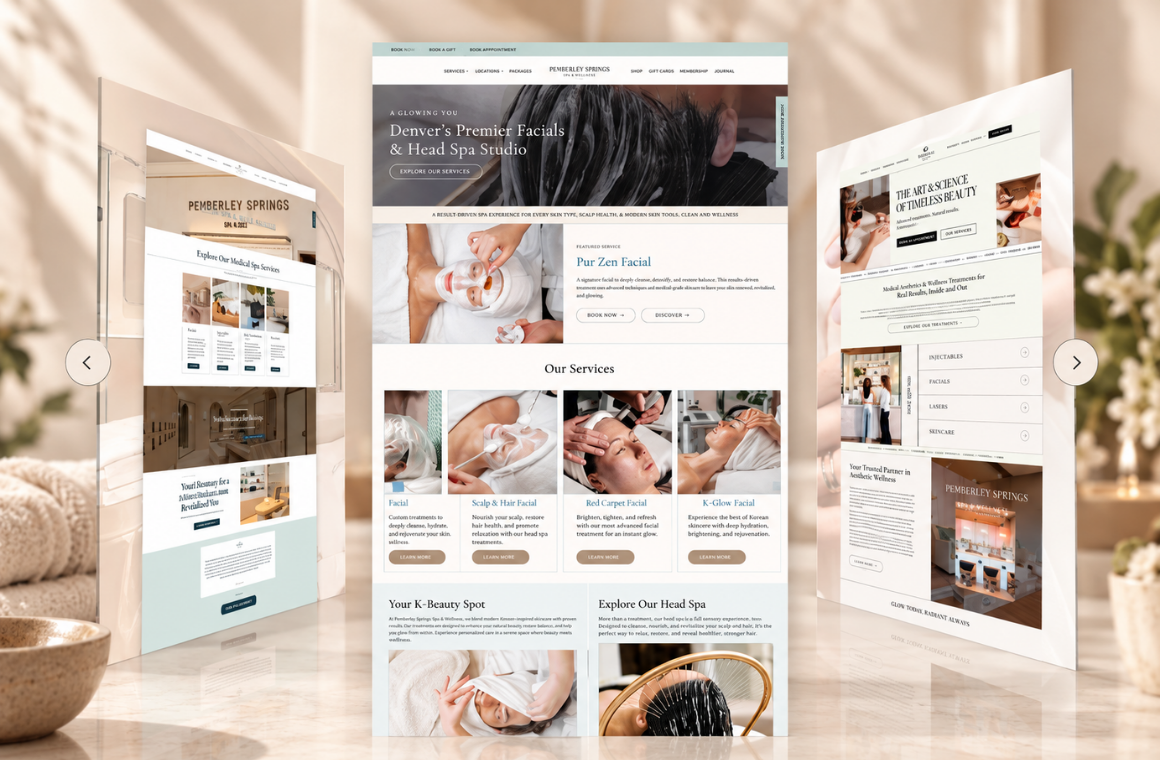
Your medspa’s website is no longer just something patients browse before booking, it’s the primary source AI tools like ChatGPT, Perplexity, and Google’s AI Overviews read from when someone asks for a treatment recommendation nearby. If your site is slow, poorly structured, or thin on real content, AI tools have very little to work with, and they simply recommend a competitor’s clinic instead. Below, our team at BOWO Creative, based in Toronto, explains exactly why website structure has quietly become an AI visibility factor, and what a medspa site needs to actually get cited.
TL;DR, Key takeaway: AI search tools recommend businesses based on what they can clearly read and trust from a website, clear service descriptions, real credentials, genuine reviews, and fast, well-structured pages. A medspa website built only for human visitors, without clean structure or crawlable content, is often invisible to AI tools even if it looks great to a person. Fixing this isn’t a separate project from good web design; it’s what good web design now includes.
AI search tools don’t invent answers from nothing, they pull from real web content, and a website that’s easy to read, well-structured, and genuinely informative gives an AI tool far more to work with than a vague, image-heavy site with little actual text. When someone asks an AI assistant “which medspa near me does Botox,” the tool is essentially summarizing what it can find and trust across the web, and your website is one of the strongest signals available to it.
This matters more now than it did even a year ago. BrightLocal’s 2026 research found that 45% of consumers were using AI tools for local business recommendations, up sharply from the prior year, a shift that makes website readability, not just search rankings, a genuine business factor. We see this shift directly in the medspa and aesthetic clinic websites we build across Toronto and the GTA, where clients ask increasingly specific questions about how their site shows up in AI answers, not just Google rankings.
AI tools favor websites that state things clearly rather than requiring inference. That means individual, clearly labeled pages for each treatment rather than one vague “services” page, plain-language descriptions of what a treatment involves, and visible, specific information about location, credentials, and pricing ranges. Ambiguity that a human visitor might tolerate, a services page split loosely across a homepage, or pricing hidden behind a contact form, often means an AI tool simply skips over the clinic entirely in favor of one that states things plainly.
Fast load times and clean technical structure matter too, since AI crawlers, like search engines, have limited patience for slow or broken pages. A site that’s difficult to crawl is difficult to cite, regardless of how good the actual services are. Our full breakdown of what makes a medspa website actually convert covers these same structural fundamentals in more depth, since good web design and AI visibility are increasingly the same project, not two separate ones.
Yes, in a very practical sense. AI tools generally pull from content that’s been successfully crawled and indexed, and a slow-loading or poorly structured site reduces how much of it gets processed at all. If key treatment information sits behind heavy scripts, unclear navigation, or pages that take too long to load, that content may simply never make it into what an AI tool has available to summarize.
This is the same technical foundation that matters for traditional SEO, which is part of why AI visibility and good web design have become the same conversation rather than two separate projects. A site built well for search engines is generally well-positioned for AI tools too, provided the content itself is clear and specific enough to be worth citing.
Beyond technical structure, the actual content on the page matters enormously. AI tools tend to favor content that directly and specifically answers real questions, which means:
A site with strong visuals but thin, vague text often loses to a plainer competitor site that simply states more clearly what it offers and to whom.
The most direct way to check is to ask an AI assistant a question your own prospective patients might ask, “best medspa for Botox in [your city],” for example, and see whether your clinic appears, and if so, what the AI tool says about it. If your clinic doesn’t appear, or the description is vague or outdated, that’s a strong signal the site isn’t giving AI tools enough clear, current information to work with.
It’s also worth checking whether your treatment pages are genuinely distinct and specific, or whether they’re thin variations of the same generic content, AI tools, much like search engines, tend to skip over content that doesn’t add clear, distinguishing information.
Not sure how your medspa currently shows up in AI search? Book a free AI visibility and website audit with BOWO Creative or call 416 990 0126, we’ll show you exactly what AI tools can and can’t see on your site right now.
The distinction between “web design” and “AI visibility” is disappearing, a website built with clear structure, specific content, and fast performance now serves both a human visitor deciding whether to book and an AI tool deciding whether to recommend you at all. Treating these as one project, rather than two separate initiatives, is the difference between a site that keeps working as search behavior shifts and one that quietly becomes invisible.
Not exactly, though they overlap significantly. Traditional SEO focuses on ranking in search results, while AI visibility is about being clearly and accurately summarized by an AI tool. A well-optimized site for search engines is usually a strong starting point for AI visibility too, but clarity and specificity in the actual content matter even more.
Not necessarily. Many clinics can improve AI visibility significantly by restructuring existing content, splitting a vague services page into individual treatment pages, adding an FAQ section, and tightening page speed, without a full redesign.
Yes, and this is one of the most common gaps we see. Heavy visual design with thin or vague text can look excellent to a human visitor while giving an AI tool very little specific, quotable content to work with.
Improvements to page structure and content can be indexed within a few weeks, though building a consistently strong presence across AI tools tends to compound over a few months, similar to traditional SEO timelines.
| Cookie | Duration | Description |
|---|---|---|
| cookielawinfo-checkbox-analytics | 11 months | This cookie is set by GDPR Cookie Consent plugin. The cookie is used to store the user consent for the cookies in the category "Analytics". |
| cookielawinfo-checkbox-functional | 11 months | The cookie is set by GDPR cookie consent to record the user consent for the cookies in the category "Functional". |
| cookielawinfo-checkbox-necessary | 11 months | This cookie is set by GDPR Cookie Consent plugin. The cookies is used to store the user consent for the cookies in the category "Necessary". |
| cookielawinfo-checkbox-others | 11 months | This cookie is set by GDPR Cookie Consent plugin. The cookie is used to store the user consent for the cookies in the category "Other. |
| cookielawinfo-checkbox-performance | 11 months | This cookie is set by GDPR Cookie Consent plugin. The cookie is used to store the user consent for the cookies in the category "Performance". |
| viewed_cookie_policy | 11 months | The cookie is set by the GDPR Cookie Consent plugin and is used to store whether or not user has consented to the use of cookies. It does not store any personal data. |

Stop chasing keywords and start building topical authority. Learn how to position your brand to be the primary source for AI-generated answers.
