
By the time a prospective patient lands on a clinic’s website, a great deal has usually already happened. She has asked a question, compared a few names, and formed an early impression of who seems credible and who doesn’t. The website she is now looking at rarely starts that process. Increasingly, it only confirms where she already landed.
We recently walked through how differently the major AI platforms describe the same clinic, four different pictures of one practice, and any owner who has run that check knows how uneven the results can be. The more interesting question isn’t why the pictures differ. It’s what a patient does with whichever picture she happens to see first.
A clinic’s website used to be one of the first places a prospective patient encountered the practice. Increasingly, it isn’t.
Before searching for a clinic by name, many patients now ask a broader question first, something closer to “who is good for [treatment] in [city]” put to an AI assistant rather than typed into a search bar. That question surfaces a shortlist before the patient has visited a single website. By the time she does click through, she is often not exploring with an open mind. She is checking whether the clinic matches an impression she already formed somewhere else.
We call the stretch between a patient’s first question and her first website visit the Pre-Visibility Window. It is the period of research that happens before a clinic has any visibility into what is being asked, compared, or decided.
Nothing in this window shows up in a clinic’s website analytics. No page view, no session, no bounce rate. The clinic has no way of knowing a decision is forming, because none of it happens on any property the clinic controls or can measure. By the time a visit is recorded, the outcome of the Pre-Visibility Window may already be largely settled.
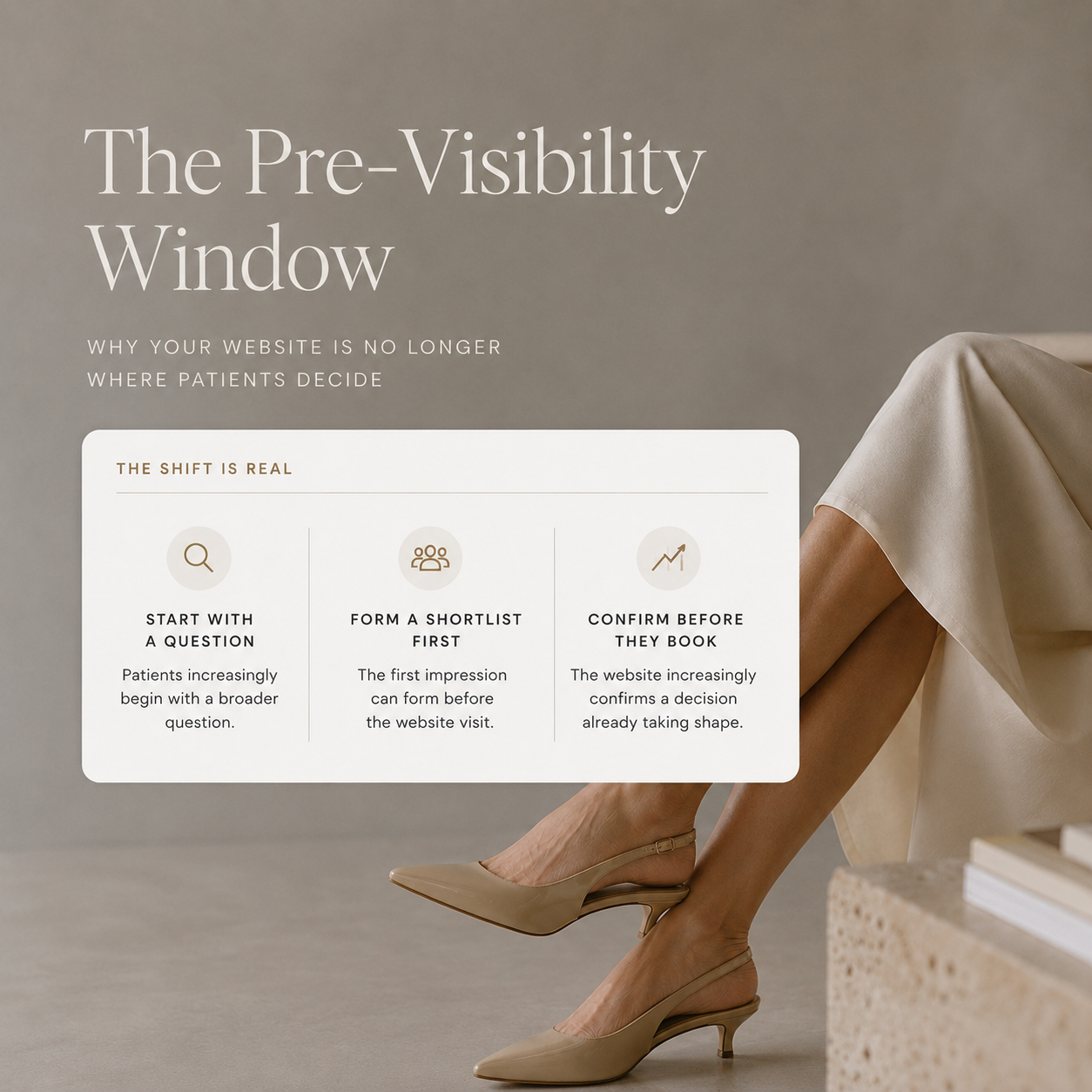
Picture a patient’s decision as a walk through three doors.
Behind the first door, she asks a broad question and receives a shortlist, shaped by whatever she consulted, an AI assistant, a friend, a review site. Behind the second door, she compares that shortlist, reading whatever she can find about each name, narrowing without any clinic present to shape the conversation. Only behind the third door does she arrive at a clinic’s website.
A clinic’s website is not one door among three. It is the only door with a window built into it, the only stage of this process a clinic can actually watch happen. The first two doors are already closed by the time the third one opens.
The model is worth keeping in mind not because it is complicated, but because it is easy to forget. Website analytics quietly imply that the website is where the story begins, simply because it is the only chapter analytics can read. Three Doors, One Window is a reminder that it rarely is.
This changes what a website is actually for. A website used to be reasonably described as a clinic’s first impression. For a meaningful share of prospective patients today, it is closer to a second or third impression, arriving after an AI assistant has already named the clinic, described it, or left it out entirely.
That doesn’t make the website less important. It changes which job the website is doing. A strong website can still confirm a favourable impression, answer lingering questions, or reassure a hesitant patient. What it increasingly cannot do is create a first impression that was never available to shape, because the shaping already happened, in a conversation the clinic never saw.
Across the clinics we have reviewed, two versions of this same dynamic show up repeatedly.
An owner will describe a new patient who arrives already decided, who mentions during the consultation that she “read good things” about a specific provider, without being able to say exactly where. In conversations like this, no website visit sits at the origin of that impression. Something read or asked elsewhere did the early work. By the time she called to book, the website’s job was simply to confirm what she already believed.
The reverse pattern is just as telling. Clinics with strong, well-designed websites sometimes report inquiry volume that doesn’t match the quality of that design, an unremarkable flow of new inquiries despite a site that would normally be expected to perform well. In several of these cases, the explanation had little to do with the website itself. The clinic simply wasn’t part of the shortlist patients were forming before they ever reached it.
For a clinic owner, this reframes where competitive advantage is actually built. Website quality, clear service pages, strong visual presentation, is still worth investing in. But it operates almost entirely within the confirmation stage of a longer process. A patient who never considered a clinic during her Pre-Visibility Window is unlikely to be recovered by a better website, because she never saw it as a candidate to compare in the first place.
This is not a case for abandoning website investment. It is a case for recognizing that a well-built website answers a narrower question than most clinics assume: not “will this patient choose me,” but “will this patient, having already leaned toward me, feel confirmed in that choice.” The earlier question, whether a patient leans toward a clinic at all, is being answered somewhere the clinic currently has little visibility into.
Put simply, a clinic can be doing everything right on its own website and still be losing patients it never knew were in play, at a stage no current measurement system was built to see.
None of this suggests the website has become unimportant, or that a clinic’s current marketing has been wasted. It suggests that a meaningful part of the patient’s decision is being made earlier than most measurement systems currently capture, and that the quality of a clinic’s presence during that earlier window may now be doing more to shape who books than owners have had reason to appreciate.
The useful question isn’t whether this is happening. In some form, for most practices, it almost certainly is. The useful question is whether a clinic has any visibility into the first two doors, or whether it only ever sees the third.
If you have noticed a version of this in your own practice, a patient who arrived already decided, or interest that didn’t match your website’s quality, we would be glad to hear about it. Reply and tell us what you have seen.
For clinics who want to understand what is happening during their own Pre-Visibility Window, the AI Visibility Audit looks specifically at that stage. It is one way to explore this further, not a required next step.
| Cookie | Duration | Description |
|---|---|---|
| cookielawinfo-checkbox-analytics | 11 months | This cookie is set by GDPR Cookie Consent plugin. The cookie is used to store the user consent for the cookies in the category "Analytics". |
| cookielawinfo-checkbox-functional | 11 months | The cookie is set by GDPR cookie consent to record the user consent for the cookies in the category "Functional". |
| cookielawinfo-checkbox-necessary | 11 months | This cookie is set by GDPR Cookie Consent plugin. The cookies is used to store the user consent for the cookies in the category "Necessary". |
| cookielawinfo-checkbox-others | 11 months | This cookie is set by GDPR Cookie Consent plugin. The cookie is used to store the user consent for the cookies in the category "Other. |
| cookielawinfo-checkbox-performance | 11 months | This cookie is set by GDPR Cookie Consent plugin. The cookie is used to store the user consent for the cookies in the category "Performance". |
| viewed_cookie_policy | 11 months | The cookie is set by the GDPR Cookie Consent plugin and is used to store whether or not user has consented to the use of cookies. It does not store any personal data. |

Stop chasing keywords and start building topical authority. Learn how to position your brand to be the primary source for AI-generated answers.
