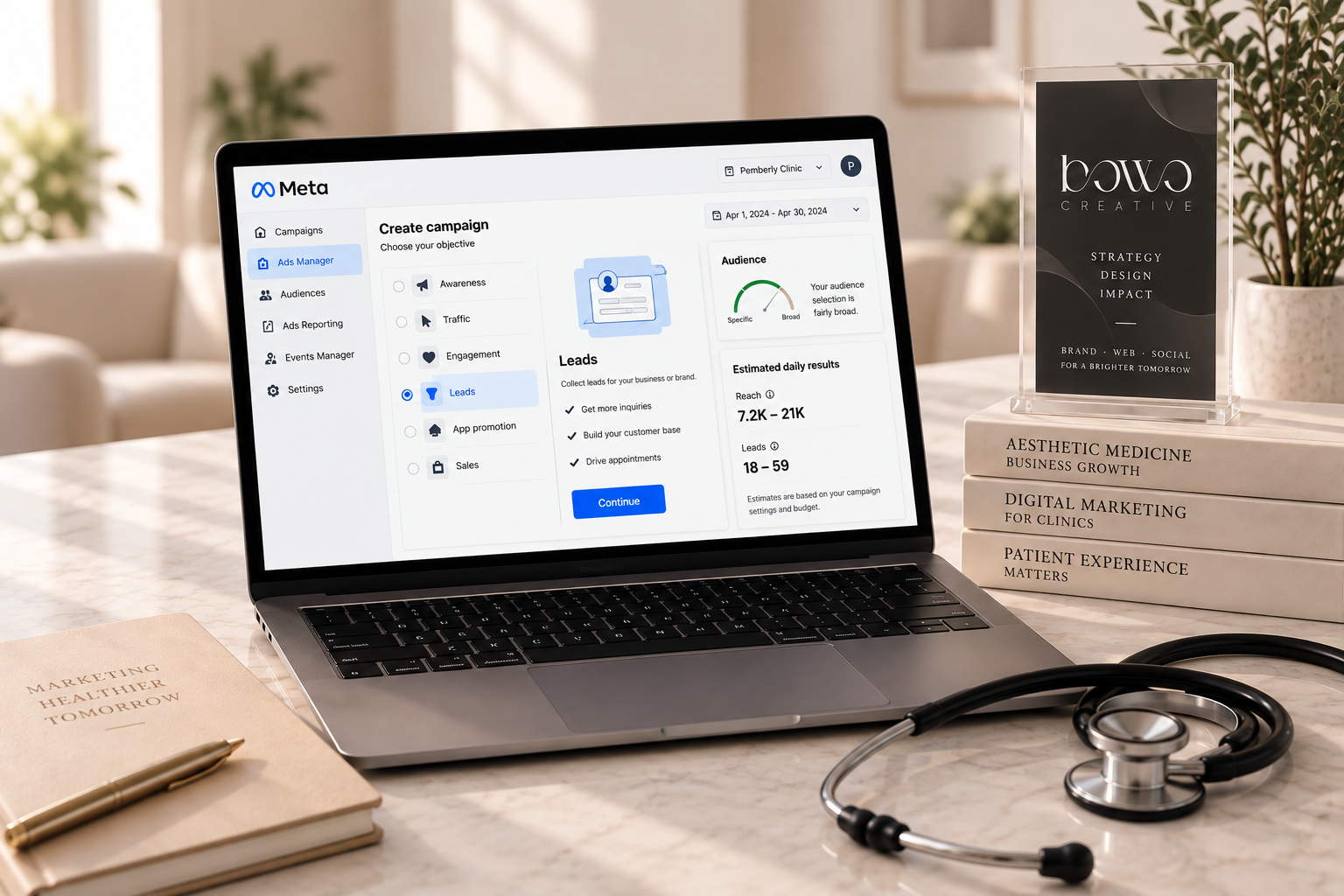
The best Meta ads for medical spas rarely look like traditional advertising, they look like a genuine moment: a real client’s reaction after a treatment, a practitioner explaining what to expect, or a calm, well-lit clip of the clinic itself. Below, our team at BOWO Creative, based in Toronto, walks through the ad formats that consistently perform for medspa clients, with a breakdown of exactly what makes each one work, so you can see the pattern rather than just copy a single example.
TL;DR, Key takeaway: The medspa Meta ads that convert best fall into five formats: user-generated content (UGC) testimonials, practitioner talking-head videos, before-and-after content shown responsibly, static problem-solution graphics, and behind-the-scenes clinic footage. What they share is authenticity over polish, ads that feel like a genuine moment outperform ads that feel like advertising. If you’re only going to build one format first, start with UGC.
A strong medspa Meta ad example typically has three things in common regardless of format: a hook in the first second that stops the scroll, a clear sense of who the ad is for, and a next step that feels low-pressure rather than pushy. The specific visual, a testimonial, a clinic tour, a practitioner explaining a treatment, matters less than whether these three elements are present.
The weakest examples we see share the opposite pattern: a slow open (often a logo or a static image before anything happens), no clear audience, and a hard sell close. If an ad example you’re looking at doesn’t hook attention immediately, the rest of the format almost doesn’t matter. This holds true whether the clinic is in downtown Toronto competing for attention against a dozen nearby medspas, or in a smaller market with less local competition.
This is typically the highest-converting format for medspas, and it’s also the simplest to produce. A real client, filmed on a phone rather than professional equipment, talks briefly about their experience, what brought them in, how the appointment felt, and how they feel about the result. No script, no studio lighting.
What makes this format work is precisely what makes it look unpolished: it reads as a genuine recommendation rather than an advertisement, which is exactly the trust signal a prospective patient is looking for before booking something personal. For a deeper breakdown of how to collect and use this kind of content, see our guide on using user-generated content to fill your medspa booking page.
In this format, a real injector, esthetician, or practitioner speaks directly to camera about a treatment, what it involves, who it’s suited for, and what to expect during recovery. This works particularly well as an educational ad rather than a promotional one, which aligns with a broader shift in medspa advertising: educational content now consistently outperforms promotional content on Meta, since it builds trust and tends to face fewer platform restrictions than results-focused ads.
The strongest examples of this format keep the practitioner’s tone calm and informative rather than salesy, and focus on one specific question a prospective patient is likely to have, rather than trying to cover an entire treatment in thirty seconds.
Before-and-after imagery remains one of the most persuasive formats in aesthetics, but it’s also the one with the most platform restrictions to navigate carefully. The examples that perform best and stay compliant tend to avoid dramatic “reveal” framing or side-by-side comparisons, and instead show the treatment process itself, a client’s genuine reaction, or a practitioner narrating the results without exaggerated claims. Reviewing Meta’s own advertising standards directly is worth doing before building this specific format, since the health and beauty category rules are unusually specific and change periodically.
Given how frequently this format runs into platform review issues, it’s worth understanding the specific rules before building one, our guide on Meta advertising rules for medspas in 2026 covers exactly what’s currently restricted and what still performs well within those limits.
Not every effective medspa ad is video. A clean, single static image naming one specific concern and outcome, paired with simple, calm copy, remains one of the cheapest formats to produce and test. These typically work best as a complement to video formats rather than a replacement, since they’re fast to produce in multiple variations for quick testing.
The examples that convert best in this format avoid clinical or alarmist language about the “problem” being addressed, favouring supportive, neutral wording instead, a pattern that both performs better and stays further from platform compliance issues.
This format shows the physical space, the team, and the day-to-day feel of the clinic, often filmed as a simple walkthrough rather than a produced video. It works particularly well for prospective patients who are nervous about a first visit, since it answers an unspoken question: what will this actually feel like when I walk in?
This format also pairs naturally with authentic branding photography, since both serve the same purpose, showing the real clinic rather than a generic or stock representation of one. Our guide on the Filter-Free Standard for medspa branding photography goes deeper into why this authenticity matters for trust specifically.
Want these formats built and tested for your specific clinic, not just described? Book a free ads audit with BOWO Creative or call 416 990 0126, we’ll show you which of these formats fits your clinic’s brand and current results.
If you’re starting from nothing, begin with a UGC testimonial, it’s the cheapest to produce, generally the highest-converting, and the lowest compliance risk of the five formats above. From there, add a practitioner video and a static problem-solution graphic to round out a small testing set, then layer in behind-the-scenes and before-and-after content once you have a baseline of what’s already working.
Running three to five different examples at once, rather than betting everything on one format, is the fastest way to learn what your specific audience responds to, a principle covered in more depth in our guide on beauty brand Meta ad creative that converts.
The through-line across every example above is the same: medspa Meta ads that convert feel like a genuine moment rather than a pitch. Start with one or two formats, particularly UGC and practitioner video, test them properly, and build outward from whichever resonates most with your specific audience.
Want a full set of ad examples built and tested for your clinic? Book your free audit with BOWO Creative or call 416 990 0126, and we’ll map out exactly which formats fit your brand.
BOWO Creative 4711 Yonge St, 10th Floor, Toronto, ON M2N 6K8 · 416 990 0126
UGC testimonials consistently perform best across most medspa accounts, since they combine low production cost with high trust. That said, the "best" format varies by clinic and audience, which is why testing multiple formats matters more than picking one in advance.
No, and often the opposite is true. UGC-style content filmed on a phone typically outperforms highly produced video, because it reads as authentic rather than promotional. Professional production is worth it for practitioner videos and clinic tours, but isn't required to get started.
With caution. Before-and-after content remains one of the more heavily reviewed formats on Meta, so it's worth understanding current platform rules before building one to avoid rejections or limited delivery.
Three to five different creatives running simultaneously against the same audience is a good starting range. This gives Meta's delivery system enough variety to identify what performs best without spreading a small budget too thin.
| Cookie | Duration | Description |
|---|---|---|
| cookielawinfo-checkbox-analytics | 11 months | This cookie is set by GDPR Cookie Consent plugin. The cookie is used to store the user consent for the cookies in the category "Analytics". |
| cookielawinfo-checkbox-functional | 11 months | The cookie is set by GDPR cookie consent to record the user consent for the cookies in the category "Functional". |
| cookielawinfo-checkbox-necessary | 11 months | This cookie is set by GDPR Cookie Consent plugin. The cookies is used to store the user consent for the cookies in the category "Necessary". |
| cookielawinfo-checkbox-others | 11 months | This cookie is set by GDPR Cookie Consent plugin. The cookie is used to store the user consent for the cookies in the category "Other. |
| cookielawinfo-checkbox-performance | 11 months | This cookie is set by GDPR Cookie Consent plugin. The cookie is used to store the user consent for the cookies in the category "Performance". |
| viewed_cookie_policy | 11 months | The cookie is set by the GDPR Cookie Consent plugin and is used to store whether or not user has consented to the use of cookies. It does not store any personal data. |

Stop chasing keywords and start building topical authority. Learn how to position your brand to be the primary source for AI-generated answers.
