TL;DR, Key takeaway: Local SEO for healthcare is the work of making a clinic, medical practice or medspa appear when nearby patients search for care. In Toronto and the GTA, it depends on three things: a complete Google Business Profile, consistent listings and reviews, and service pages that name the treatments and the neighbourhoods you serve. Results vary, and most practices see movement over months, not days.
If a patient in North York searches “dermatologist near me” or “medspa in Toronto,” Google shows a short list of nearby practices before it shows anything else. Local SEO for healthcare is how a practice earns a place on that list. This guide explains how it works, what changes between a family doctor, a multi-location clinic and a medspa, and the steps to start with.
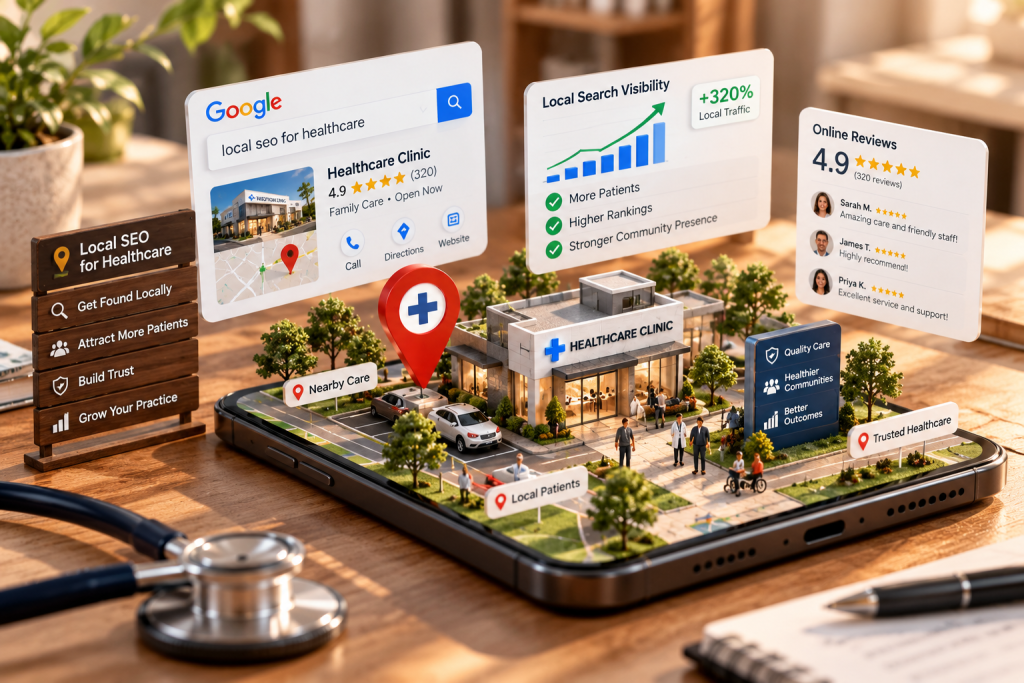
Local SEO for healthcare is the process of improving a medical practice’s visibility in local search results, including the Google Maps “local pack,” so that nearby patients can find, trust and contact it. It covers your Google Business Profile, your website’s location and service pages, online reviews, and the consistency of your name, address and phone number across the web.
For a Toronto practice, that means appearing for searches like “walk-in clinic Etobicoke,” “botox near me” or “medical spa Yorkville,” not only for broad terms.
Three things set healthcare apart from other local businesses.
Patients search with urgency and intent. Someone looking for a clinic has usually decided to book and is choosing who to call. That puts weight on the local pack, reviews and how quickly a patient can reach you.
Google holds health content to a higher standard. Health pages are judged more strictly on experience, expertise, authoritativeness and trustworthiness. Unsupported medical claims can hold a page back even when the rest of the SEO is sound.
Advertising rules apply. Clinics in Ontario work within the advertising guidance of their regulatory college. Content should avoid guarantees and overstated outcomes. This is general information and not legal advice, so confirm specifics with your college or a qualified lawyer.
Google says local results are based mainly on three factors: relevance, distance and prominence. Its own guidance on improving your local ranking describes each one.
You cannot change distance. You can improve relevance and prominence, and that is where local SEO work goes.
The mechanics are the same, but the priorities shift with the type of practice.
Solo doctor or small practice | Multi-location clinic | Medspa or aesthetic clinic | |
|---|---|---|---|
Main goal | Be found for “doctor near me” | Rank each location separately | Be found for treatments, then book |
Key asset | One strong Google Business Profile | One page and one profile per location | Treatment pages and before/after policy |
Common gap | Few reviews | Duplicate or thin location pages | Profile photos and treatment pages |
Compliance focus | Claims about outcomes | Consistent information across sites | Hedged results, consent for photos |
If you run a medspa, our guide to SEO for medspas and beauty brands covers the service side in more detail. For a broader view of the topic, see Healthcare SEO Agency: What Separates a Good One.
Start with this order. Each step builds on the one before it.
If you want a second opinion on where your profile and pages stand, book a free local SEO audit and we will point out the first fixes.
It depends on how competitive your area is and how complete your profile and site are today. Many practices see changes in profile views and calls within a few months, while competitive neighbourhoods and treatments take longer. Treat any promised timeline with caution, because results vary.
Toronto searches are specific to neighbourhoods and cities. Patients search by area, so name the places you serve in a natural way: Toronto, North York, Etobicoke, Scarborough, Mississauga, Markham, Vaughan and Oakville. Mention a neighbourhood only where you serve patients, and put it in context, such as how to reach you or which treatments are available locally.
Voice and AI search follow the same pattern. A question like “where can I find a medical spa near me in Toronto” is answered by pages that state the service, the location and the contact details together.
Local SEO for healthcare is the work of making a clinic or medical practice appear in Google Maps and local search results when nearby patients look for care. It includes your Google Business Profile, location and service pages, reviews and consistent listings.
Doctors usually compete for "near me" searches for general care, so the profile and reviews matter most. Medspas compete on specific treatments, so treatment pages, photos and consent policies matter more. Both need accurate, hedged content.
Google bases local results on relevance, distance and prominence. Complete your Google Business Profile, keep your details consistent, earn genuine reviews and build location and service pages. No one can guarantee a position.
There is no fixed number. A steady flow of recent, genuine reviews with replies from the practice matters more than a single large batch.
Yes. Each location should have its own page and its own Google Business Profile, with unique details and not copied text.
Many practices see early changes in a few months, but results vary by competition and by how complete the profile and site are at the start.
| Cookie | Duration | Description |
|---|---|---|
| cookielawinfo-checkbox-analytics | 11 months | This cookie is set by GDPR Cookie Consent plugin. The cookie is used to store the user consent for the cookies in the category "Analytics". |
| cookielawinfo-checkbox-functional | 11 months | The cookie is set by GDPR cookie consent to record the user consent for the cookies in the category "Functional". |
| cookielawinfo-checkbox-necessary | 11 months | This cookie is set by GDPR Cookie Consent plugin. The cookies is used to store the user consent for the cookies in the category "Necessary". |
| cookielawinfo-checkbox-others | 11 months | This cookie is set by GDPR Cookie Consent plugin. The cookie is used to store the user consent for the cookies in the category "Other. |
| cookielawinfo-checkbox-performance | 11 months | This cookie is set by GDPR Cookie Consent plugin. The cookie is used to store the user consent for the cookies in the category "Performance". |
| viewed_cookie_policy | 11 months | The cookie is set by the GDPR Cookie Consent plugin and is used to store whether or not user has consented to the use of cookies. It does not store any personal data. |

Stop chasing keywords and start building topical authority. Learn how to position your brand to be the primary source for AI-generated answers.
