A clinic doubles its ad spend. Leads double right along with it. Three months later, revenue has barely moved, and the owner concludes the ads stopped working.
The ads probably didn’t stop working. “We need more leads” is usually an incomplete diagnosis. A lead is only worth what happens to it inside the system it lands in, and more leads don’t fix that system. They just reveal, faster and more expensively, whether the system actually works.
Lead volume feels like the lever because it’s the easiest one to pull. Spend more, get more form fills, expect more patients. But lead volume is one input into growth, not growth itself. Treating it as the whole equation is how clinics end up paying more for the same result.
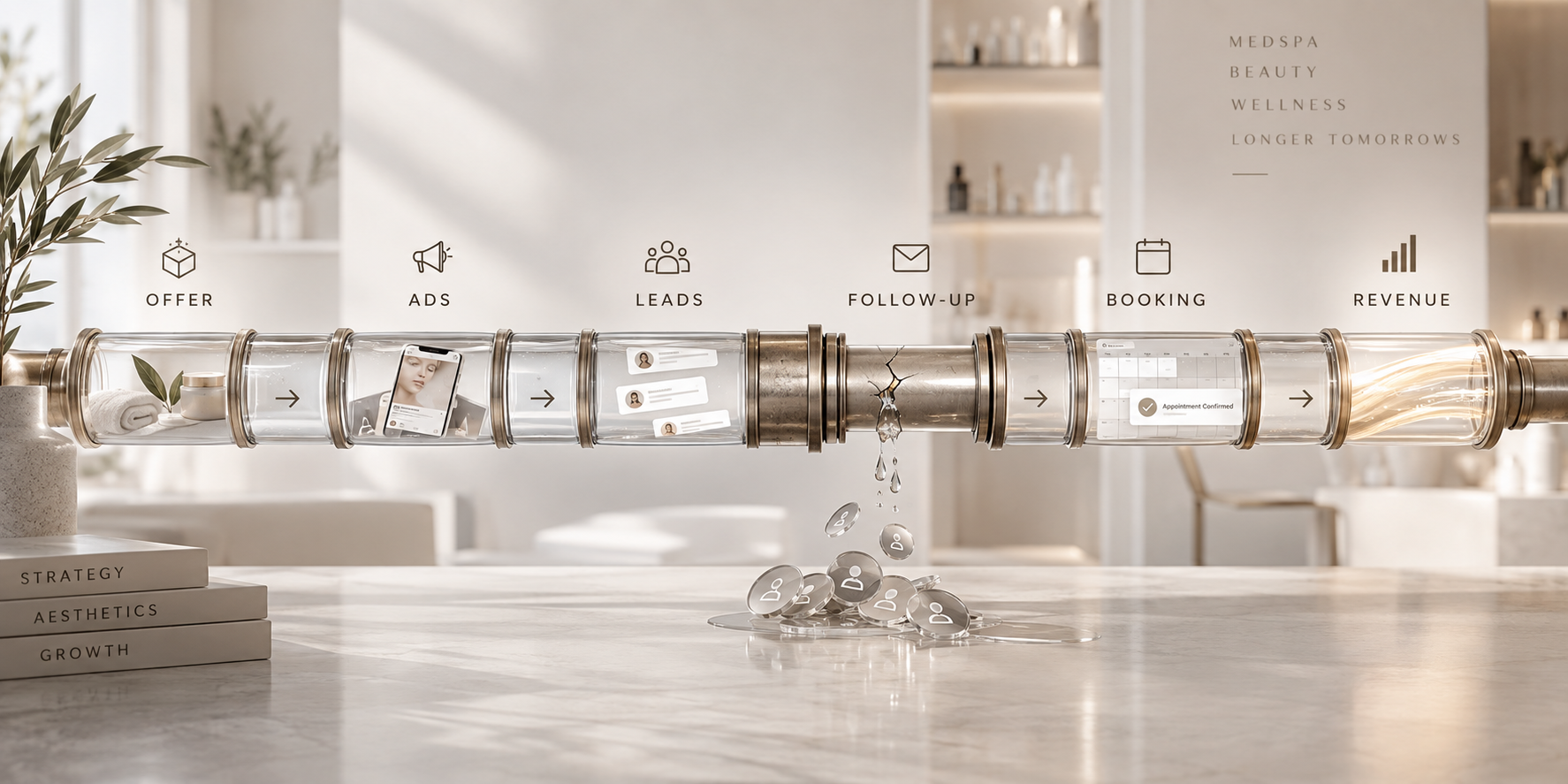
A medspa growth system is the connected chain that turns ad spend into patients: offer, ads, lead, follow-up, consultation, booking, revenue. Every link in that chain has to hold for a dollar of ad spend to become a patient in the chair. Most clinics that feel like marketing isn’t working have actually built a strong front half: a decent offer, ads that generate real interest. It’s sitting on top of gaps further down the chain that never get diagnosed, because the front half is the only part anyone’s watching.
Sometimes it’s the offer: clear enough to generate clicks, not compelling enough to generate action. The prospect is curious, fills out the form, then goes quiet when a consultation is suggested, because nothing gave her a reason to commit.
Sometimes it’s lead quality, with ads bringing in volume that was never a strong fit for the clinic’s actual services. These are real people, but they wanted something the clinic doesn’t offer, or at a price it doesn’t charge, so they stall at the first conversation.
And sometimes it’s a plain operational gap, where no one clearly owns what happens to a lead in the first hour, or the booking process carries more friction than the offer can survive. An inquiry that waits until tomorrow gives an interested person time to choose a faster competitor.
None of this shows up in an ad performance report. All of it shows up in revenue.
A lead is not the outcome. It is the beginning of a process. Lead generation gets someone to raise a hand. Lead conversion is everything that happens next, and it moves through stages:
Lead → Contact → Conversation → Consultation Booked → Consultation Showed → Patient → Revenue
Each stage is a place where someone can drop out, for different reasons. This is a way to see the process, not a benchmark for what any clinic should expect. What it shows is that two clinics can generate the same number of leads and get very different outcomes. One contacts every lead quickly, has a real conversation, and makes booking simple. The other lets inquiries sit until interest fades. The ad reports look identical. The revenue doesn’t.

A weak link in the system can handle ten leads a month without the cracks showing. It can’t handle a hundred. More volume doesn’t repair a gap. It multiplies how much runs through it unconverted. Increasing spend on a system with a hidden gap often makes the return on that spend look worse, not better, simply because scale reveals the leak faster than anyone fixes it.
Lead volume tells you how much demand enters the system. Conversion data tells you whether the system works.
Lead count and cost per lead describe only the front of the journey. A clinic that wants to know if its marketing system is working should be able to answer a handful of questions.
These numbers matter because each one points to a different part of the system. Contact rate and response time show whether leads are being reached while their interest is still fresh. Conversations show whether the first exchange gives people a reason to continue. Consultations booked reflect the strength of the offer and the ease of the booking process, show rate reflects how well interest holds between booking and the visit, and patient conversion reflects what happens once someone is in the room. Read together, they show which part of the system needs attention instead of leaving a clinic to guess.
The goal isn’t to optimize one metric in isolation. A clinic can improve response time and still lose people at booking, or lift bookings while show rate slips. What matters is understanding the full journey from lead to revenue.
The most useful question sits underneath all of them: where are leads dropping out? That answer tells you which link to fix before you spend another dollar on volume.
A clinic with a working growth system has an offer specific enough to convert interest into action, ads pointed at the right audience for that offer, and a clear, owned handoff the moment a lead comes in. Not a vague sense that someone follows up eventually. Getting that handoff right is its own conversation, and next week’s piece goes deep on exactly what should happen in the hours and days after a lead lands, since that’s where most of the leakage described here actually occurs.
BB10X isn’t an advertising package layered on top of a clinic’s existing setup. It’s BOWO’s growth system for medspas, designed around the connected chain described above: offer, ads, lead handling, follow-up, and booking, working together so lead volume converts into revenue instead of exposing a gap further down the line.
That design follows directly from the problem. If the offer is weak, better ads only bring in more of the wrong response. If follow-up is slow, better targeting only sends more leads into the same delay. Fixing one link while ignoring the others is how a clinic ends up with a strong front half and a leaking back half. BB10X treats paid ads for medspas as one part of that chain, not the whole thing.
Scaling lead generation without fixing conversion doesn’t solve a growth problem. It scales the leak.
Why isn’t more ad spend growing my medspa?
If leads aren’t converting into booked, paying patients at a healthy rate, more spend just generates more unconverted leads. The issue usually sits somewhere in the offer, lead quality, or the process after the lead arrives, not in the ad itself.
What’s the difference between lead generation and lead conversion?
Lead generation gets someone to raise their hand. Lead conversion is everything that happens after, and it’s what determines whether that raised hand becomes a patient.
What is BB10X?
BOWO’s growth system connecting offer, ads, and lead handling so marketing activity converts into measurable growth rather than just more unconverted leads.
How do I know if my clinic has a system problem instead of a lead problem?
Compare lead volume to booked-consultation rate. A large gap between the two, not a shortage of leads, is usually the signal.
| Cookie | Duration | Description |
|---|---|---|
| cookielawinfo-checkbox-analytics | 11 months | This cookie is set by GDPR Cookie Consent plugin. The cookie is used to store the user consent for the cookies in the category "Analytics". |
| cookielawinfo-checkbox-functional | 11 months | The cookie is set by GDPR cookie consent to record the user consent for the cookies in the category "Functional". |
| cookielawinfo-checkbox-necessary | 11 months | This cookie is set by GDPR Cookie Consent plugin. The cookies is used to store the user consent for the cookies in the category "Necessary". |
| cookielawinfo-checkbox-others | 11 months | This cookie is set by GDPR Cookie Consent plugin. The cookie is used to store the user consent for the cookies in the category "Other. |
| cookielawinfo-checkbox-performance | 11 months | This cookie is set by GDPR Cookie Consent plugin. The cookie is used to store the user consent for the cookies in the category "Performance". |
| viewed_cookie_policy | 11 months | The cookie is set by the GDPR Cookie Consent plugin and is used to store whether or not user has consented to the use of cookies. It does not store any personal data. |

Stop chasing keywords and start building topical authority. Learn how to position your brand to be the primary source for AI-generated answers.
